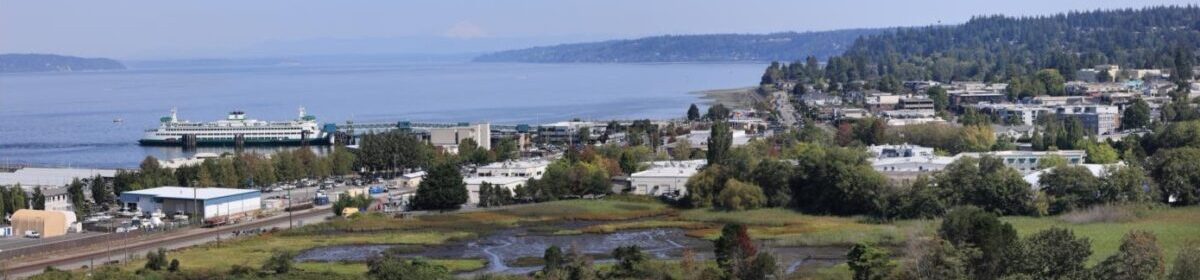
Edmonds Marsh today with orange water buckets at each new tree planted. (Photo by John Brock)
If you’ve been in the ferry holding lanes lately or driven on Highway 104 just south of Dayton Street, you might have wondered what’s happening with all the orange buckets on the west side of the road. Well, what you’re seeing is a watering scheme, designed to ensure tree growth during the hot summer for the new trees planted by the Edmonds Marsh Volunteer Restoration Project.
If you take a closer look, you might also notice new growth on the taller alder trees and new 10-plus-foot willow trees growing along the bank of the newly reopened Shellabarger Creek, which flows south on the west side of the highway. And then, you might realize this improved landscape would not exist had it not been for dedicated community volunteers who willingly dredged through deep mud and dense invasive vegetation in order to restore a creek channel and a forested buffer/riparian zone free of invasive plant overgrowth. Volunteers actually removed over 900 feet of chain-link fence and four 10-yard dump truck loads of nightshade.
Here’s what the nightshade-covered site looked like in April 2022 before restoration. (Photo by Joe Scordino)
The Edmonds Marsh Volunteer Restoration Project, coordinated and supervised by the all-volunteer Edmonds Stream Team under an agreement with the Washington State Department of Transportation (WSDOT), started as a four-year seasonal project to remove chain-link fencing enmeshed with bittersweet nightshade (a fast-growing invasive plant that killed trees and blocked creek flow) on both sides of Highway 104. After volunteers successfully achieved the project objectives of the first four-year WSDOT agreement (for example, a fully reopened creek channel and restored stream bank), the project is now under a second four-year WSDOT agreement to maintain the restored area by preventing invasive regrowth and enhancing tree growth.
At the outset of the project, some were skeptical that a community volunteer project (without grant funding or expensive consultants) could succeed. However, dedicated volunteers (with community donations for field gear and WSDOT assistance in trucking away tons of nightshade and removed chain-link fencing) proved them wrong. By year three of the seasonal volunteer work (July-September), the project achieved its objective to reopen a free-flowing creek for future salmon passage.
Volunteers who are very proud of their accomplishment pose with the totally reopened creek in August 2023. (Photo by Chris Walton)
The project shifted in 2024 to riparian zone improvements involving stream bank restoration with wood chips and new trees as well as preventing nightshade regrowth and allowing “recovered” trees to repopulate. Volunteer enthusiasm wasn’t dampened by discontinued work in the City-owned portion of the marsh nor the expanded beaver dams in the middle of the marsh that compromised the project’s ecological goals for improved freshwater circulation.
The project is in its sixth year, with continued emphasis on maintaining and enhancing the restored site. Although dedicated volunteers are ready and willing to resume weekly work parties, the project is now in an “only-when-needed” approach if/when the Stream Team’s ongoing citizen science monitoring program identifies field work that can be safely accomplished by volunteers.
So, maybe those orange buckets along Highway 104 will also serve to remind everyone what a great community we have with so many people willing to help make “An Edmonds Kind of Day.”
Joe Scordino is project leader for the Edmonds Stream Team.
Several thousand baby coho salmon from the Willow Creek Salmon Hatchery in Edmonds were released into local streams on Saturday.
Imogen and Adelia ready to release baby salmon into Willo Creek. (Photo by Emily Benson)
This hatchery has raised salmon since the mid-1980s, and in recent years, under management by Sound Salmon Solutions, has focused on re-introducing and bolstering coho salmon populations in Edmonds’ streams, such as Shell Creek, Perrinville Creek, Willow Creek, Shellabarger Creek, Lunds Gulch Creek and Northstream Creek.
Adelia Benson with her cup of baby salmon.
Releases of baby coho salmon (called ‘salmon fry’) into local streams now involve volunteers of all ages to promote public engagement in enhancement of the quality stream habitat that these fish need to survive.
Saturday was no different with adults, students, and young families helping release the salmon fry into Shell Creek in Yost Park and into Willow Creek next to the Hatchery.
Imogen carefully releases her salmon.Hatchery Manage Megan Moran scoops salmon into cups.Fry are off and running, er, swimming.
The Edmonds City Council at its Tuesday, April 28 business meeting will consider a $383,456 amendment to consultant contract for the second phase of a flow reduction study in the Perrinville drainage basin.
The city has been working for years to develop strategies to control flooding on Perrinville Creek between Talbot Road and Puget Sound. A flow reduction study in 2015 resulted in a list of recommendations, from drainage improvements to a municipal raingarden program.
The City of Lynnwood, which sends stormwater runoff to the basin, is partnering with the Edmonds on the project. Both cities were awarded a $469,200 state Department of Ecology grant toward this effort to analyze the problem, which requires $82,800 in local matching funds from Edmonds and Lynnwood. The grant and matching funds are split bet
According to the staff agenda memo regarding this item, the grant and matching funds are split between the two cities. The amendment to the professional services agreement is $383,456 and includes a $20,455 management reserve, the memo states.
“In 2024, Edmonds and Lynnwood entered into an interlocal agreement and contracted Herrera Environmental Consultants to provide design services for the study update, the memo says. “Phase 1 of the study update involved a review of the recommended projects and planning level design and estimating work of new projects. Projects were rated based on criteria including impact on flows, constructability and cost effectiveness.”
The contract’s second phase “will include a more in-depth analysis, including geotechnical investigations for the sites that include mitigation via infiltration, for the 10 highest-scoring flow reduction projects from first phase of the study update. Once the analysis is completed, the project rankings will be reassessed and the consultant will provide conceptual design for the six highest-scoring sites.”
Other items on the council agenda include:
2025 Prosecutor’s Office Annual Report
2025 Public Defender’s Office Annual Report
The council will also hear an update from Police Chief Loi Dawkins on the public safety sales tax.
The meeting will begin at 6 p.m. in the council chambers, Public Safety Complex, 250 5th Ave. N., Edmonds. You can also access the meeting remotely at this Zoom link. Or listen by phone at +1 253 215 8782. The meeting ID is 957 9848 4261.
A student releasing salmon one cup at a time. (Photos courtesy Joe Scordino)
Fourth graders from St Thomas More School in Lynnwood were enthralled this week to release 100 coho salmon babies that they had successfully raised from eggs in their school aquarium, according Edmonds Stream Team leader Joe Scordino.
As part of the Washington Department of Fish and Wildlife (WDFW) Salmon in Schools program (now called School Cooperative Program), the Edmonds Stream Team obtained 100 coho salmon eggs in January from WDFW’s Issaquah Hatchery and delivered them to the fourth graders’ aquarium at St. Thomas More School.
The students raised 100 coho salmon babies from eggs in their school aquarium.The St. Thomas More fourth-grade class with their salmon in a transport bucket.
Raising baby salmon has been a special part of being in 4th grade at St. Thomas More School for many years, Scordino said. The students learn about the life cycle of salmon and the importance of healthy streams where these fish live — and get to actually see salmon eggs hatch and transition from the “alevin” stage (with a yolk sac) to the “fry” stage when they begin feeding in the aquarium.
“Over 500 schools in Washington have participated in the Salmon in Schools program, and it no longer surprises me when a young adult will tell me they still remember the joy of having a salmon aquarium at their school,” Scordino said.
Edmonds Stream Team leader Joe Scordino, right, watches as a student gets ready to release a baby salmon into Willow Creek.
“This year was especially exciting for St. Thomas More in that the fourth graders, with the help of teacher Kari Hopper, made sure all of the 100 salmon eggs hatched and became salmon fry that were then carefully released into Willow Creek — no mortalities,” Scordino added.
It’s now that time of year when the Edmonds Stream Team and Sound Salmon Solutions are working with community volunteers to place ‘baby’ coho salmon from the Willow Creek Salmon Hatchery in Edmonds into local creeks. The 2- to 3-month-old ‘baby’ coho (called salmon ‘fry’) will bolster local populations whose habitat has been affected by development and stormwater.
At Perrinville Creek, neighborhood families, along with students from Meadowdale High School, helped release 4,000 coho salmon fry into the upper creek (near the Perrinville Post Office).At Shellabarger Creek along the Hwy 104 Marsh Restoration Project, members of the Edmonds Rotary Club and restoration volunteers captured 1,000 coho salmon fry from the Hatchery pond and released them into the restored, re-opened creek (previously enmeshed with invasive bittersweet nightshade).
Next Sunday, March 29, 5,000 coho fry will be released into Lunds Gulch Creek in Meadowdale Beach Park around 10:00am near the wood bridge (visitors are welcome to watch). On May 16, Sound Salmon Solutions will release 3,500 coho into Shell Creek in Yost Park (see SSS website).
The two-inch coho salmon fry will spend their first year of life in freshwater streams and then go out to sea where they’ll grow into 2-foot+ adult salmon. Then in fall of 2028, the survivors will return to freshwater streams as spawning adult salmon to create future salmon generations. The adult spawners will return to the creeks where they were born, or in the case of these fry to the creeks that they lived in (and imprinted to) prior to going out to sea. Unfortunately, for the Perrinville Creek salmon, they won’t be able to return unless the blockage the City placed in 2021 is removed (for detail on the blockage see 7/15/25 My Edmonds News article on the Edmonds Environmental Council’s complaint about the City’s illegal diversion structures).
The community salmon enhancement program is authorized under Cooperative Agreements between the Washington Dept. of Fish and Wildlife, the Edmonds Stream Team, and Sound Salmon Solutions.
Joe Scordino, Project Leader Edmonds Stream Team Edmonds.Envir.Council@gmail.com
The Edmonds Stream Team is a community all-volunteer Citizen Science project to monitor and improve the condition of Edmonds creeks and nearshore wetlands to enhance salmon and wildlife populations (and benefit people who appreciate preservation of our natural resources)
On Oct. 16, a group of Edmonds-Woodway High School students with the Students Saving Salmon Club were performing routine water quality testing in Shellabarger Creek when they saw something disturbing: a young coho smolt swimming weakly on its side. On the shore nearby was another dead coho smolt.
The Washington Department of Fish and Wildlife (WDFW) has granted the City of Edmonds an expedited permit allowing crews to begin debris-clearing work at the city’s controversial flow-diversion structure on lower Perrinville Creek – a move that environmental advocates say again sidesteps long-standing legal and safety obligations.
An overflow diversion structure sits along a section of Perrinville Creek near Talbot Road on Monday, Sept. 16, 2024, in Edmonds, Washington. (Olivia Vanni / The Herald)
EDMONDS — The Washington Department of Fish and Wildlife issued a new permit to the city of Edmonds on Friday, allowing flood-prevention work to commence at a controversial flow diversion structure on Perrinville Creek.
During heavy rains the sediment traps get overwhelmed by high flows. The current temporary permit allows the city to clean the traps in advance of this fall’s rainy season. (Photo courtesy City of Edmonds)
There’s a new development in the decades-long tug-of-war between the City of Edmonds, the State Department of Fish and Wildlife (DFW), environmental groups and adjacent property owners to balance flood control and fish passage on lower Perrinville Creek. The DFW has issued a limited temporary permit to allow the City of Edmonds to clear accumulated debris from the city’s existing sediment trap/overflow structures, with the aim of mitigating potential flooding during the upcoming rainy season. The permit expires on Jan. 13, 2026, and work must be completed by that time.
The Edmonds Waterfront Center welcomes Edward P. Kolodziej, internationally recognized environmental chemist and the Allan and Inger Osberg Professor at the University of Washington (Tacoma/Seattle) as the featured speaker in Annie Crawley’s Environmental Speaker Series. The event takes place at 6 p.m. on Thursday, Sept. 11, the latest installment in a community-based science and conservation initiative focused on Puget Sound.
From left: Joe Scordino, Seth Zeon, Eric Monroe, Aiden Curran, Bob Seidensticker, Janelle Cass, John Brock, Heather Marks, Dianna Maish, Chris Walton, Belinda Hughes, and Sally Jo Sebring. Not pictured: Nancy Scordino and Mason Hughes. (Photo courtesy Joe Scordino)
Perrinville Creek was once a thriving, salmon-bearing stream that flowed through Edmonds and Lynnwood. Community groups like the Edmonds Stream Team used it as a teaching creek; it was a vibrant artery in our region’s watershed and a living example of environmental stewardship.
The Edmonds Marsh Restoration Volunteers were back at the reopened Shellabarger Creek along Highway 104 Saturday controlling invasive vegetation using wood chips. The volunteers are working under a new four-year Adopt-A-Highway Landscaping Agreement between the Washington State Department of Transportation and the Edmonds Stream Team. The agreement supports continued community volunteer efforts to control invasive vegetation in the Edmonds Marsh and Shellabarger Creek and to plant trees and shrubs to preserve the new stream habitat.