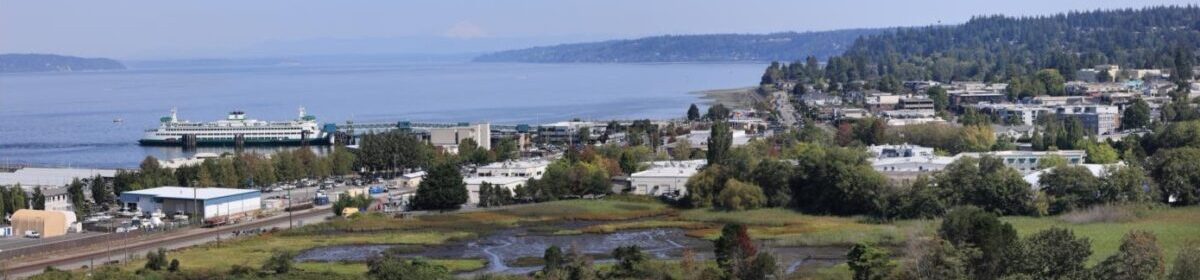
Edmonds Marsh today with orange water buckets at each new tree planted. (Photo by John Brock)
If you’ve been in the ferry holding lanes lately or driven on Highway 104 just south of Dayton Street, you might have wondered what’s happening with all the orange buckets on the west side of the road. Well, what you’re seeing is a watering scheme, designed to ensure tree growth during the hot summer for the new trees planted by the Edmonds Marsh Volunteer Restoration Project.
If you take a closer look, you might also notice new growth on the taller alder trees and new 10-plus-foot willow trees growing along the bank of the newly reopened Shellabarger Creek, which flows south on the west side of the highway. And then, you might realize this improved landscape would not exist had it not been for dedicated community volunteers who willingly dredged through deep mud and dense invasive vegetation in order to restore a creek channel and a forested buffer/riparian zone free of invasive plant overgrowth. Volunteers actually removed over 900 feet of chain-link fence and four 10-yard dump truck loads of nightshade.
Here’s what the nightshade-covered site looked like in April 2022 before restoration. (Photo by Joe Scordino)
The Edmonds Marsh Volunteer Restoration Project, coordinated and supervised by the all-volunteer Edmonds Stream Team under an agreement with the Washington State Department of Transportation (WSDOT), started as a four-year seasonal project to remove chain-link fencing enmeshed with bittersweet nightshade (a fast-growing invasive plant that killed trees and blocked creek flow) on both sides of Highway 104. After volunteers successfully achieved the project objectives of the first four-year WSDOT agreement (for example, a fully reopened creek channel and restored stream bank), the project is now under a second four-year WSDOT agreement to maintain the restored area by preventing invasive regrowth and enhancing tree growth.
At the outset of the project, some were skeptical that a community volunteer project (without grant funding or expensive consultants) could succeed. However, dedicated volunteers (with community donations for field gear and WSDOT assistance in trucking away tons of nightshade and removed chain-link fencing) proved them wrong. By year three of the seasonal volunteer work (July-September), the project achieved its objective to reopen a free-flowing creek for future salmon passage.
Volunteers who are very proud of their accomplishment pose with the totally reopened creek in August 2023. (Photo by Chris Walton)
The project shifted in 2024 to riparian zone improvements involving stream bank restoration with wood chips and new trees as well as preventing nightshade regrowth and allowing “recovered” trees to repopulate. Volunteer enthusiasm wasn’t dampened by discontinued work in the City-owned portion of the marsh nor the expanded beaver dams in the middle of the marsh that compromised the project’s ecological goals for improved freshwater circulation.
The project is in its sixth year, with continued emphasis on maintaining and enhancing the restored site. Although dedicated volunteers are ready and willing to resume weekly work parties, the project is now in an “only-when-needed” approach if/when the Stream Team’s ongoing citizen science monitoring program identifies field work that can be safely accomplished by volunteers.
So, maybe those orange buckets along Highway 104 will also serve to remind everyone what a great community we have with so many people willing to help make “An Edmonds Kind of Day.”
Joe Scordino is project leader for the Edmonds Stream Team.
The tire chemical 6PPD is known worldwide for its deadly effect on salmon, but it also has a complex history. We look at how this history connects to important breakthroughs in modern transportation and medicine and how the unique chemical structure of 6PPD makes it an environmental hazard.
The history of 6PPD-quinone intersects with the history of quinine, derived from the bark of the cinchona tree, and follows an unlikely path from malaria treatment to a deadly tire chemical.
Five and a half years ago, the world was suddenly confronted with the chemical names 6PPD and 6PPD-quinone — a pair of related chemicals that quickly became notorious for their deadly effects on coho and other salmonid species.
Since then, hundreds of scientific papers have evoked these names, as researchers worldwide struggle to determine why 6PPD-quinone (often shortened to 6PPD-Q) can be extremely harmful to some fish while nearly harmless to others.
The history of 6PPD — which logically begins in the early days of the automobile — involves decades of searching for chemicals that would allow car owners to get more mileage out of their tires. Chemicals with “PPD” in their names became central in the effort to protect tires from ozone, a ubiquitous compound that destroys rubber. Now, with the understanding that ozone converts 6PPD to the highly toxic 6PPD-quinone, the search has resumed for a less-poisonous compound that can, hopefully, protect tires as well as 6PPD has done.
As the research advances, the names 6PPD and 6PPD-quinone are becoming familiar to toxicologists and practically anyone concerned about salmon and the environment. What is rarely discussed, however, is what the letters “PPD” stand for, the meaning of the number “6” or how the word “quinone” relates to “quinine,” a traditional medicine used to treat malaria.
The following descriptions examine the history of the chemical, from the origin of its structure to its eventual use as a tire preservative.
The foundation of 6PPD in organic chemistry
The untold story of quinone
It is no accident that quinone, a class of familiar compounds, is just one letter away from quinine, the first effective treatment for malaria and considered by some to be the all-time greatest discovery in herbal medicine. The indigenous people of the Andes of South America used the bark of the cinchona tree for centuries to treat fevers and disease.
By the early 1600s, the medicinal bark was introduced to Europe after doctors found that it could treat malaria. While the bark was certainly an effective treatment, it was caught up in a controversy for a time, according to an article published by the National Institutes of Health. Uncertainty about the treatment may have been caused by impurities in the ground-up bark given to patients.
In 1820, French scientists Pierre-Joseph Pelletier and Joseph-Bienaimé Caventou isolated the active compound found in the cinchona bark. They named it “quinine” from “quina-quina” (meaning bark of barks), the Inca name for the sacred bark of the cinchona tree.
The bark of cinchona trees (left) which grow in tropical forests contains quinine, the compound credited with treating malaria. Scientists Pierre-Joseph Pelletier and Joseph-Bienaimé Caventou isolated this active ingredient in 1820, depicted in Ernest Board’s oil painting “The Discovery of Quinine” (right). Photo: Forest & Kim Starr (CC BY 3.0). Painting: Wellcome Collection (CC BY 4.0).
Because the bark was in high demand, chemists raced to synthesize quinine without relying on trees. It was a challenging endeavor, and the quest played an important role in the development of modern organic chemistry, according to a 2005 historical report by two Argentine authors.
Although the word “quinone” is just one letter away from “quinine,” the chemical relationship is more complicated. “Quinone” is wrapped up in the chemistry of the medicinal bark and predates the name “quinine,” according to scientific literature of the early 1800s.
In 1806, 14 years before the French scientists isolated quinine, Louis Nicolas Vauquelin, another French scientist, identified a natural acid in the quinquina bark, using a slight variation of the Inca name.
“Let us give it the name ‘acide kinique’ from the word ‘quinquina,’ until — when it is better known in its nature and its combinations — a better name may be given to it,” Vauquelin said in the original peer-reviewed manuscript. In English, “acide kinique” became “quinic acid.”
Vauquelin became famous for his work on quinic acid and many other discoveries. He did not know, at the time, that a German pharmacist, Friedrich Christian Hofmann, had isolated the same acid from cinchona bark in 1790 and named it “Chinasäure” (“china acid” — no connection to the country). In German, “China” remains the word for cinchona even today.
About 1838, Russian chemist Alexander Voskresensky oxidized quinic acid and obtained a yellow substance. He named it “Chinoyl,” using the ending “yl” on “Chin” to designate an organic “radical.” According to one theory at the time, a radical was considered a chemical building block that would remain stable through chemical changes.
A few years later, by 1844, German chemist Friedrich Wöhler concluded that the yellow substance was instead a complete, neutral molecule. Consequently, he renamed it “Chinon,” the German word corresponding to the English “quinone.”
Wöhler wrote: “The name ‘Chinoyl’ proposed … for this substance cannot be retained, because the ending “yl” is customarily used to designate an organic radical, which Chinon is not. I therefore give preference to the latter name, ‘Chinon.’”
For at least a few years, quinone retained its identity as an individual compound with its pair of double-bonded oxygens attached to a single ring of benzene. But by the 1860s, as chemists expanded their research into larger-ring structures, chemical dictionaries began to consider the quinones as a “class of compounds” with a specific structural pattern.
Thus, what was formerly “quinone” became “benzoquinone,” because it involved a single ring of benzene. There is also “naphthoquinone” involving the double-ringed naphthalene, “anthraquinone” involving the triple-ringed anthrylene, and so on for other ring configurations.
The list of quinones in everyday products today is quite long. While this class of chemicals tends to raise concerns because of their reactive nature, toxicity is a function of their chemical environment. Many are safely used, and some are even essential components of normal biological function.
For example, Coenzyme Q10, known as CoQ10, is a natural antioxidant found in every cell. It fuels cellular energy and protects cells from oxidative damage. Levels naturally decline in older people, especially those taking statin medications. Studies have shown that CoQ10 supplements can help certain people with specific medical conditions.
Phylloquinone (Vitamin K1), which is found in leafy green vegetables, plays a role in blood clotting. Plastoquinone, found in all green plants, is a key component in photosynthesis.
All sorts of dyes also are built from quinones, especially naphthoquinones and anthraquinones. The natural dye Henna, which provides a distinctive red-orange stain, is a naphthoquinone. Brilliant synthetic dyes Alizarin (vibrant red), Disperse Blue 3 and Solvent Orange 57 are all anthraquinones.
Natural herbal laxatives rely on anthraquinone glycosides. Widely used cancer drugs — also anthraquinone derivates — work by disrupting the DNA of cancer cells. Modern treatments for malaria are less often quinine – which is not a quinone at all — and more often drugs like Atovaquone, a highly modified variation of naphthoquinone.
Quinones are NOT found in pure hydrogen peroxide — a familiar chemical used for first-aid, cleaning with oxygen bleaches, teeth whitening and many other functions. But virtually all manufacturing of hydrogen peroxide involves the use of anthraquinones.
The history of 6PPD as a rubber preservative
The evolution of tire chemicals
Even before the invention of the automobile, a self-made chemist, Charles Goodyear, revolutionized the use of rubber and paved the way to modern tires by using chemical additives. The highly successful antiozonant 6PPD came into prominence in the 1960s — about midway through the history of tire chemistry. Many other additives with names like DPPD, IPPD and CPPD have been tried with varying success.
If told completely, the ongoing story of tire chemistry must begin with the earliest use of rubber at least 3,600 years ago. Ancient civilizations in Central America played games with rubber balls on ballcourts of various sizes, according to archeologists who have unearthed ballgame structures and equipment. The Olmec people of Southern Mexico, who predated the Mayans and Aztecs, harvested rubber from the Panama rubber tree (Castilla elastica) and used it to fashion footwear, craft tools and make rubber bands as well as rubber balls.
Europeans were fascinated with the bouncy rubber balls brought back by explorers and scientists in the early 1500s. But rubber became more of a household name after 1770, when British chemist Joseph Priestley recognized that the dried sap from these special trees could “rub out” graphite pencil marks. He named his invention “rubber,” which caught on and became the name for the material itself.
The use of natural rubber was limited by a critical property related to temperature: It becomes soft and sticky in the heat of summer, yet stiff and brittle in the cold of winter. In 1839, Charles Goodyear, living in Wolburn, Mass., made a breakthrough that would alter the course of industry when he accidentally spilled a mixture of raw rubber and sulfur onto a hot stove. The heating created crosslinks to maintain the strength of rubber at all temperatures, a process that became known as vulcanization.
The wood engraving “An Amazing Revelation” depicts Charles Goodyear discovering vulcanization after accidentally dropping rubber and sulfur onto a hot stove, circa 1839. Illustration: From James D. McCabe, 1871 engraving/Linda Hall Library (public domain)
Goodyear’s discovery launched a vast array of products, from waterproof raincoats to life jackets, along with industrial gaskets, hoses, conveyor belts and cylinder linings for steam engines.
When the first modern car — the 1886 Benz Motorwagen — came on the market, it rolled on solid rubber tires made of vulcanized rubber. The ride was slow and rough. In 1895, the Michelin brothers, André and Édouard, produced the first removable pneumatic tire, transforming automobiles from slow-moving motorized carriages to fast, long-distance vehicles.
In the early 1900s, tire chemists began blending carbon black, a fine soot, into tires to strengthen their resistance to road wear and degradation from ultraviolet light. Tires went from a light grey — the natural color of rubber — to jet black.
In 1906, chemist George Oenslager, based in Akron, Ohio, found he could speed up the slow vulcanization process with the use of “accelerators,” which are catalysts that lower the energy needed for sulfur to break its own bonds and become linked to rubber molecules. Curing time went from hours to minutes.
During the 1920s, chemists began experimenting with complex organic molecules, including chemicals in the family of phenylene diamines (PPDs). These additives helped to capture free radicals and atmospheric ozone that can break the polymer chains.
“The effect of ozone on the degradation of tire-rubber compounds was not fully understood until the 1930s,” according to a report (PDF) by the Interstate Technology and Regulatory Council. “At that time, a typical tire lasted only 10,000 miles or roughly two years.”
During World War II, supplies of natural rubber from Asia became limited, so chemical engineers in the U.S. and Russia invented synthetic rubber produced from crude oil. Their products fulfilled wartime needs for rubber until rubber-tree supplies resumed after the war. During the 1950s, chemists improved the formulas for synthetic rubber, and by the mid-1960s synthetic materials outpaced natural rubber in tires.
After World War II, the U.S. Army maintained an extensive inventory of vehicles, whose tires were experiencing cracking and deterioration. Government chemists conducted a search for compounds to better preserve the rubber. They were aware of earlier antiozone compounds, such as DPPD (diphenyl-PPD, and IPPD (isopropyl-PPD).
While DPPD and IPPD both helped, DPPD reacted too slowly with ozone to fully solve the problem, and IPPD reacted so quickly that it was prematurely used up, according to the ITRC report. The “Goldilocks” chemical, with the right reactivity and ability to migrate to the rubber’s surface layer, turned out to be 6PPD, the “6” standing for a six-carbon unit as part of the PPD structure.
In 1965, the Monsanto Company obtained patent rights to the antiozonant 6PPD, which the company marketed under the trade name Santoflex 13, just one product in a line of Santoflex antioxidants. After the patents expired in the 1980s, other companies began producing and selling 6PPD, sometimes mixed with other compounds. Today, 6PPD is found in nearly every tire on the road. For other PPD derivatives, check out the table in the technical document by California’s Department of Substances Control.
Now that 6PPD has become associated with environmental problems, some of these other PPD compounds have been considered as a replacement. One candidate is CCPD, a compound that has been known to chemists for years and appears to be much less toxic to coho than 6PPD.
While 6PPD is highly effective at blocking the damaging effects of ozone on tires, the chemical reaction with ozone leads to 6PPD-quinone, one of the most toxic chemicals ever produced.
Ground-level ozone is a highly reactive compound produced under energetic conditions, such as when sunlight strikes pollutants in automobile exhaust. Ground-level ozone should not be confused with the atmospheric “ozone layer,” an essential feature of our planet that helps to block damaging ultraviolet rays. On the road, ozone is known to break the chemical bonds of rubber in tires, leading to degradation and shortening a tire’s life. The value of 6PPD is that this chemical is able to capture the ozone before it can attack the rubber. In the process, we get the formation of 6PPD-quinone.
That is the long and cumbersome name for an amazing, yet dangerous chemical used in tires, abbreviated as 6PPD. It is a complex, multi-functional compound with a complex name to match. It’s no wonder that this formal name is rarely used except at the beginning of scientific articles.
While this complex name may seem intimidating, untangling the nomenclature is not so difficult if you understand that organic chemistry is something like Tinker Toys, Legos or a map of highways connecting cities together. Atoms link to each other according to basic rules of nature — such as carbon atoms each providing four links of attachment to other atoms. The nomenclature thus follows the structure.
Ignoring the energy consumed or delivered in chemical reactions, we can build 6PPD and other closely related chemicals from a structural point of view, starting with benzene, one of the basic compounds in organic chemistry, and then adding onto it. In common terms, C stands for carbon, H for hydrogen, N for nitrogen and O for oxygen.
Figure 1. The chemical structure of 6PPD starts with benzene (A), depicted here two ways. Carbons are assumed to be in the corners the simpler, lower version. To benzene, two amino groups (B) are added, resulting in p-phenylenediamine (C). An additional benzene ring is then added by replacing a hydrogen in one amino group, resulting in N′-phenyl-p-phenylenediamine (D) to which 1,3-dimthylbutyl- (E) is added. The result is 6PPD. Graphic: PSI
Figure 1A shows the location of carbon and hydrogen atoms of benzene and below that a simplified version, in which carbons are assumed to occupy the corners and hydrogen atoms go where needed to complete the picture. Note the four connections for each carbon atom, with double bonds counting as two.
To the benzene ring (drawn as a hexagon for convenience), we need to add two amino groups (—NH2) (FIgure 1B) on opposite sides (Figure 1C). Amines are interesting, because they are found in many biologic systems. Adding a hydrogen to an amino group gives us ammonia (NH3). Adding a carbolic acid group (—COOH) and a side chain can lead to one of many amino acids — the building blocks of protein and other biological compounds.
According to chemical nomenclature, if we attach one chemical group to a benzine ring, the basic ring is known as “phenyl.” If we add two groups, the ring becomes “phenylene.” So if we add two amino groups to our benzene ring, it becomes phenylene diamine, “di” meaning two (Figure 1C).
The location of the amino groups also comes into play. When they are opposite each other on the ring, as in 6PPD, they are called “para,” and may be designated with the letter “p.” Now we have the last half of our complex name for 6PPD: “p-phenylenediamine,” or “PPD” This is a recurring structure in the most basic search for alternatives to 6PPD.
Now we will build onto our growing structure, starting with an add-on to one amino group on p-phenylenediamine. This is done by replacing a hydrogen on the amino group with a phenyl group (another benzene ring). The accent mark (“prime”) on the “N” is used simply to tell one nitrogen atom from another. We now have N′-phenyl-p-phenylenediamine (Figure 1D).
Let’s now construct the last piece to be added, the 1,3-dimethylbutyl group (Figure 1E). It starts with a butyl group, which has four carbons, and then adds two methyl groups, each with a single carbon. The methyl groups are added to the first and third carbon atoms in the butyl group, thus giving us 1,3-dimethylbutyl (Figure 1E).
Next, we attach the 1,3-dimethylbutyl group to the nitrogen on the available amino group that is part of N′-phenyl-p-phenylenediamine, completing the 6PPD structure: N-(1,3-dimethylbutyl)-N′-phenyl-p-phenylenediamine (Figure 2).
Figure 2. The “6” in 6PPD comes from the six carbon atoms in the attached dimethylbutyl group. Graphic: PSI
Where does the name “6PPD” come from? The PPD part is the p-phenylenediamine that we constructed in this exercise. The number 6 comes from a shorthand used years ago by chemists in the rubber industry and eventually adopted as official nomenclature by the International Organization for Standardization. The “6” itself comes from the six carbon atoms that are found in the attached dimethylbutyl group.
Other compounds using numbers for naming include 7PPD and 8PPD, specific compounds that contain seven- and eight-carbon chains, respectively, attached to one of the two amino groups on PPD. Others are 77PD, which have identical 7-carbon chains, one attached to each of the amino groups. Likewise, for 88PD.
Among the earliest antiozone compounds were DPPD, or diphenyl-PPD, and later IPPD, or isopropyl-PPD (Figures 3A and B). “Diphenyl” indicates two phenyl groups, one on each of the amines of PPD. “Isopropyl” indicates a three-carbon propyl group (as in propane) with the attachment point on the middle carbon.
Since 6PPD has come under fire for its environmental problems, other PPD compounds are being considered as a replacement, including CCPD (Figure 3D). Like 77PD and 88PD, the double letters “CC” represent twin groups on opposite ends of our PPD structure. Specifically, CCPD has two cyclohexyl groups, while CPPD (Figure 3C) has one cyclohexyl group and one phenyl group. “Cyclo” means “circle,” so cycohexyl (and cyclohexane) is a six-carbon benzene ring with hydrogen atoms in place of double bonds between the carbons.
Figure 3. Early antiozone compounds used in tire manufacturing include DPPD (A) and IPPD (B) which differ in their phenyl and isopropyl groups. Replacement compounds for 6PPD under consideration include CPPD (C), and CCPD (D), which differ in their phenyl and cyclohexyl groups. Graphic: PSI
What scientists didn’t know until December 2020 was that many of the PPD compounds — most significantly 6PPD — produce a quinone structure while reacting with ozone. The chemical name for 6PPD-quinone is:
You don’t see that name often; most chemists just go with the abbreviation 6PPD-quinone or 6PPD-Q.
To understand the transformation, let’s start with simple benzene and bring in ozone (O3). The result is benzoquinone, as shown in Figure 4:
Figure 4. Ozone oxidizes benzene to phenol, which the diagram shows becomes more reactive, then converts to 1,4-benzoquinone. Graphic: PSI
Notice the two double-bonded oxygens tied to carbons on the benzene ring. From benzene, we can advance to ozone oxidation — or ozonation — of 6PPD (Figure 5):
Figure 5. Ozone oxidizes 6PPD through hydroxylation of the aromatic ring to produce 6PPD-quinone, the toxic compound that kills coho salmon. Graphic: PSI
As we have seen, the nature of this chemical class called quinones can be both toxic and beneficial, going well beyond the positive effects of 6PPD and the dangerous effects of 6PPD-Q. The questions now become: Can one or more safer replacements for 6PPD be found? Will chosen chemicals avoid the formation of quinone, or will they be designed with quinones that do not disrupt biological functions?
Stories from the people protecting and recovering Puget Sound
July 7, 2026 Written by Sara Bruestle, freelance writer
Photo courtesy of Kitsap County
Salmon are icons in Washington: Their long-distance migrations shape the state’s natural environment and robust economy. Strong salmon runs are vital to healthy ecosystems, the fishing and tourism industries, Tribal treaty rights, food security, cultural heritage, and a way of life.
With 14 salmon and steelhead populations in Washington listed under the Endangered Species Act, their recovery is a statewide investment. Washington is investing billions to restore and protect fish habitat and address threats to salmon.
One of the state’s strategies for salmon recovery is improved stormwater management. Salmon need clean streams, rivers, wetlands, estuaries, and oceans as they migrate hundreds or even thousands of miles during their lifecycles. Despite laws and regulations aimed at protecting water, population growth has contributed to increasing pollution in these waterways.
As cities and towns expand, the number of roads, bridges, and parking lots increases, resulting in more pollutants running into surrounding watersheds. Stormwater runoff can harm fish, limiting their survival rate. One pollutant derived from tires is exceptionally deadly to some salmon.
Gorst Creek
The Gorst Creek watershed on the Kitsap Peninsula is one top-ranked location the Washington State Department of Transportation (WSDOT) is prioritizing in efforts to improve water quality in critical fish habitat. It supports runs of Chinook, coho, and chum salmon, as well as steelhead and cutthroat trout.
The Suquamish Tribe releases 1.8 million salmon into the creek each year. As the salmon leave the Tribe’s rearing ponds, they imprint on the unique odors and geomagnetic fields of the Gorst Creek watershed. This ensures that years later the salmon can migrate back to their home stream to spawn.
The watershed is also home to the notorious Gorst bottleneck, where Highway 3 and Highway 16 merge at the head of Sinclair Inlet. The interchange funnels over 85,000 vehicles daily, as it serves as the main land connection between the Kitsap Peninsula and the rest of Puget Sound.
Traffic heavily backs up during Seattle-Bremerton ferry sailings and Puget Sound Naval Shipyard shift changes. Thousands of cars passing through the narrow corridor get stuck in the Gorst gridlock several times a day.
Chemicals, like those from tires, are released on roads and washed into local bodies of water where they harm salmon and other aquatic life. Credit: iiievgeniy
When it rains, pollution from the traffic washes from Gorst Creek into Sinclair Inlet, including 6PPD-quinone (6PPDQ), a toxic chemical that forms when tires degrade and that researchers identified as fatal to coho salmon in 2020.
For these reasons and more, the Suquamish Tribe and Kitsap County have marked the Gorst Creek watershed as a top priority for stormwater mitigation on WSDOT’s Stormwater Retrofit Prioritization Web Map.
“Sinclair Inlet is a pretty heavily impacted body of water because there’s a lot going on right there in Gorst,” says Joe Rutan, Kitsap County’s county roads engineer. “It’s a highly developed area that is in need of change, and we want to make sure the county is involved in that change.”
Prioritization Map
WSDOT launched the interactive web map in 2024 to pinpoint needs for stormwater retrofit projects that mitigate stormwater impacts from the state transportation system. This collaborative planning tool maps and prioritizes locations along 14,561 miles of state highway for future mitigation.
The state legislature earmarked stormwater retrofits that aid in salmon recovery, ecosystem health, reducing pollution, and addressing health disparities, pledging $500 million in a Move Ahead Washington transportation funding package.
WSDOT surveyed Tribes, towns, cities, counties, and conservation groups, asking them to rank their top priorities for stormwater upgrades. Since the map’s launch, many locations have been top ranked by more than one respondent.
WSDOT’s interactive Stormwater Retrofit Prioritization Web Map shows high priority segments of highway across the state.
“We would like to capitalize on this high level of interest and leverage our investments by accomplishing more than WSDOT could do on its own through partnerships,” says Tatiana Dreisbach, WSDOT’s stormwater retrofit outreach and innovation lead.
The map incorporates perspectives and expertise from across the state to help WSDOT update a transportation system that was primarily built before the Clean Water Act. Through partnerships, those surveyed can steer project plans toward solutions that provide the greatest return on investment – perhaps removing fish barriers or upgrading streambank protection at the same time.
“The WSDOT Stormwater Retrofit Program is working to create and streamline partnership pathways to collectively do more with limited resources, to strategically develop and redevelop the built environment in smart ways,” Dreisbach says.
WSDOT turns to the map when compiling an annual list of standalone stormwater retrofit projects for Move Ahead Washington funding.
Of the 14,561 miles of highway prioritized on the map, 63% are ranked a high priority due to pollution, 30% are ranked a high priority for the salmon population, and 3% are ranked high for existing health disparities. Twelve percent of the highways, or 1,680 miles, score high in all three areas of concern. This includes the Gorst Creek watershed.
Toxic Stormwater
Decades ago, coho salmon traveling upstream through urban waterways to spawn started showing alarming symptoms: They were disoriented, rolling onto their sides, gasping for air, and dying before they could lay their eggs. No one understood why.
For years, scientists tested the water and ruled out typical culprits like heavy metals, disease, high water temperatures, and low oxygen levels. The actual killer was an invisible byproduct of tires.
In 2020, Washington State University and University of Washington researchers linked 6PPDQ to these mass die-offs of coho salmon around Puget Sound over the last 25 years.
Water monitoring data helps Kitsap County meet regulatory requirements and make informed decisions about future water quality improvement projects. Photo courtesy of Kitsap County.
Tire manufacturers use a preservative called 6PPD to prevent rubber from cracking. As tires roll, they shed rubber dust onto roads. When the dust reacts to ozone in the air, the 6PPD transforms into 6PPDQ.
As 6PPDQ is recognized to be one of the most toxic pollutants to fish, there is a widespread urgency to address stormwater impacts. Trace levels – as low as 41 to 95 parts per trillion – are lethal to coho salmon and harmful to other sensitive salmonids, such as steelhead and cutthroat trout. As little as half a drop in an Olympic-sized swimming pool can be lethal. Researchers found that exposed coho salmon experienced mortality rates of 40% to 100%. The fish can die within hours.
In response, the state legislature authorized $500 million over 16 years, starting in 2023, for WSDOT stormwater retrofits as part of its Move Ahead Washington funding package. An additional $15 million was added in 2023 for the legislature’s request, which emphasizes green solutions such as bioswales.
Moving Ahead
WSDOT’s Move Ahead Washington pilot project is on the other side of Puget Sound, 68 miles from Gorst by highway. The Ship Canal Bridge Stormwater Treatment Facility in Seattle will filter polluted runoff from I-5 before it flows into Lake Union.
The project’s scope could treat stormwater from up to 80 acres across multiple jurisdictions, making it WSDOT’s largest standalone stormwater retrofit project to date. It also represents the busiest stretch of highway in the state: Nearly 240,000 vehicles travel across the bridge daily.
“The Ship Canal Bridge has the highest volume of traffic, so it’s some of the dirtiest water coming from the state transportation infrastructure,” Dreisbach says. “This project will be a huge win for water quality and salmon enhancement.”
WSDOT is in the pre-design phase for the project, which includes data collection and community engagement for the planning and development of three design alternatives. Treatment facility construction is expected to begin in 2028.
Over Move Ahead Washington’s 16 years, the state legislature has ambitiously committed to fund $515 million for stormwater retrofit projects. However, recent budget constraints have limited Washington’s ability to provide a steady stream of funding.
WSDOT faces some challenges with the current funding schedule. No funding is allotted between 2027 and 2031, while over $300 million is budgeted between 2035 and 2039. With cash flow issues, the department will be pressed for time and resources to deliver results.
“WSDOT cannot implement a steady stream of stormwater retrofit projects due to funding gaps and pulses, limiting WSDOT’s ability to address urgent stormwater impacts from 6PPDQ and other pollutants in the near term,” Dreisbach says, adding that the hope is that the legislature will optimize the package’s funding schedule.
Kitsap County staff collect information on water quality, stream conditions, and aquatic habitat to identify potential issues, track trends over time, and assess whether stormwater management efforts are effectively protecting streams. Photo courtesy of Kitsap County.
Tribal Interests
Since 2024, 15 federally recognized Tribes have marked 50 locations on WSDOT’s Stormwater Retrofit Prioritization Web Map as top priorities for stormwater mitigation, most of them along state highways encompassing Puget Sound: Ground Zero for 6PPDQ. Tribal rankings are elevated to the top of the list for project scoping. Not only does WSDOT value Tribal rights and interests, but Tribes’ priorities such as water quality and salmon recovery merge with the department’s.
The Suquamish Tribe marked the Gorst Creek watershed as a top priority for stormwater mitigation because it is a 6PPDQ hotspot and the location of salmon restoration work. In addition to its Gorst Creek Rearing Facility, the Tribe operates two Chinook rearing ponds and yearling raceways in the creek. All together, the Tribe’s annual hatchery runs add up to an estimated 2.1 million salmon. While 1.8 million Chinook salmon are released into the creek, another 300,000 coho are transferred to the nearby Agate Passage net pens.
“For more than 40 years, the Suquamish Tribe has operated the Gorst facility to protect and enhance salmon populations,” says Charlie Kratzer, Suquamish Tribe’s hydrologist. “Through a network of hatcheries, rearing facilities and marine net pens the Tribe supports ceremonial, subsistence, and commercial harvests while contributing to the long-term recovery of natural salmon stocks.”
The Suquamish Tribe and Kitsap County hope that the Gorst Creek watershed will make WSDOT’s project shortlist. Kratzer and Rutan agree that the WSDOT Stormwater Retrofit Prioritization Web Map is a useful tool that will help meet the state’s priorities for stormwater management improvements. They’re both interested in partnering on a stormwater retrofit project that will filter contaminants like 6PPDQ from polluted runoff before it reaches streams, helping improve salmon survival.
“How our county roads interact with the state roads and the water is important,” Rutan says. “We need to address that in an environmentally sensitive, caring way.”
Other Ways Washington is Addressing Stormwater Impacts
Washington leads the nation in addressing 6PPD and its toxic derivative, 6PPDQ, following its discovery in 2020. Funding stormwater retrofits that treat the salmon-killing chemical is just one of many strategies in addressing the crisis. In addition:
Tribes petitioned the Environmental Protection Agency (EPA) to establish risk-management rules to restrict or eliminate 6PPD use in tires. The EPA granted the petition in 2023.
In 2024, Washington became the first state to pass legislation regulating 6PPD in tires. It requires manufacturers to report consumer products that contain 6PPD.
The Washington State Department of Ecology (Ecology) is collaborating with manufacturers to find alternate chemical preservatives that could replace 6PPD in tires, and evaluate if those chemicals are actually safer.
Cities are implementing specialized bioretention systems such as rain gardens and engineered soils to filter out 6PPDQ in stormwater runoff, preventing the chemical from washing into waterways. Ecology is also testing new stormwater treatment technologies.
Ecology now oversees statewide water testing in critical streams, wetlands, and estuaries to monitor the presence of 6PPDQ. The data is used to track 6PPDQ hotspots to guide stormwater management and targeted water-quality cleanup projects.
In 2024, Washington was also the first state to establish a numeric water-quality limit for 6PPDQ to regulate contamination. The legal limit is 12 parts per trillion.
During the 2026 state legislative session, the House introduced a bill requiring manufacturers to phase out 6PPD in tires sold in Washington. Although the bill didn’t pass, legislators are likely to propose similar bills in the future.
The Washington State Department of Transportation is implementing Box of Rain, a new stormwater treatment technology, to help prevent stormwater pollutants from reaching salmon-rearing streams. Photo courtesty of WSDOT.
More WSDOT Stormwater Management Partnerships
WSDOT is also working to improve water quality throughout Washington with programs like Box of Rain, Adopt-a-Downspout, and the Roadside Vegetation & Beautification Permit.
Box of Rain is a new stormwater treatment technology developed in partnership with The Nature Conservancy and Stewardship Partners. Like a rain garden in a box, the bioretention system removes pollutants from a bridge’s downspouts before they can enter nearby waterways.
Adopt-a-Downspout is a Stewardship Partners model that asks community volunteers to maintain local Boxes of Rain. For example, the Northwest Fly Anglers have adopted the boxes installed at the Ship Canal Bridge. More volunteer opportunities are in the works.
The new Roadside Vegetation & Beautification Permit expands the scope of an existing permit for WSDOT right-of-way improvements to do more than plant trees and shrubs. It now includes stormwater mitigation to reduce pollutants and control flows. For example, the Duwamish Valley Industrial Greening group applied for the permit to create a stormwater interpretive center in the Georgetown neighborhood of Seattle. The project plans to use the Box of Rain technology to reduce stormwater pollution from an on-ramp to I-5, provide community access to a beautified right-of-way, and install interpretive boards explaining the value of stormwater mitigation.