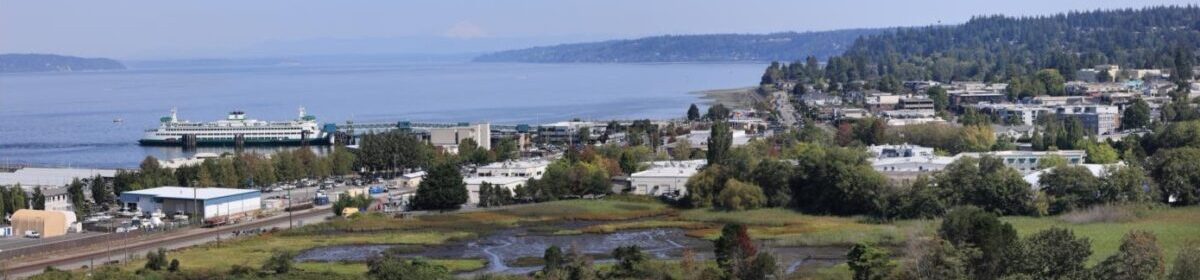
Edmonds Marsh today with orange water buckets at each new tree planted. (Photo by John Brock)
If you’ve been in the ferry holding lanes lately or driven on Highway 104 just south of Dayton Street, you might have wondered what’s happening with all the orange buckets on the west side of the road. Well, what you’re seeing is a watering scheme, designed to ensure tree growth during the hot summer for the new trees planted by the Edmonds Marsh Volunteer Restoration Project.
If you take a closer look, you might also notice new growth on the taller alder trees and new 10-plus-foot willow trees growing along the bank of the newly reopened Shellabarger Creek, which flows south on the west side of the highway. And then, you might realize this improved landscape would not exist had it not been for dedicated community volunteers who willingly dredged through deep mud and dense invasive vegetation in order to restore a creek channel and a forested buffer/riparian zone free of invasive plant overgrowth. Volunteers actually removed over 900 feet of chain-link fence and four 10-yard dump truck loads of nightshade.
Here’s what the nightshade-covered site looked like in April 2022 before restoration. (Photo by Joe Scordino)
The Edmonds Marsh Volunteer Restoration Project, coordinated and supervised by the all-volunteer Edmonds Stream Team under an agreement with the Washington State Department of Transportation (WSDOT), started as a four-year seasonal project to remove chain-link fencing enmeshed with bittersweet nightshade (a fast-growing invasive plant that killed trees and blocked creek flow) on both sides of Highway 104. After volunteers successfully achieved the project objectives of the first four-year WSDOT agreement (for example, a fully reopened creek channel and restored stream bank), the project is now under a second four-year WSDOT agreement to maintain the restored area by preventing invasive regrowth and enhancing tree growth.
At the outset of the project, some were skeptical that a community volunteer project (without grant funding or expensive consultants) could succeed. However, dedicated volunteers (with community donations for field gear and WSDOT assistance in trucking away tons of nightshade and removed chain-link fencing) proved them wrong. By year three of the seasonal volunteer work (July-September), the project achieved its objective to reopen a free-flowing creek for future salmon passage.
Volunteers who are very proud of their accomplishment pose with the totally reopened creek in August 2023. (Photo by Chris Walton)
The project shifted in 2024 to riparian zone improvements involving stream bank restoration with wood chips and new trees as well as preventing nightshade regrowth and allowing “recovered” trees to repopulate. Volunteer enthusiasm wasn’t dampened by discontinued work in the City-owned portion of the marsh nor the expanded beaver dams in the middle of the marsh that compromised the project’s ecological goals for improved freshwater circulation.
The project is in its sixth year, with continued emphasis on maintaining and enhancing the restored site. Although dedicated volunteers are ready and willing to resume weekly work parties, the project is now in an “only-when-needed” approach if/when the Stream Team’s ongoing citizen science monitoring program identifies field work that can be safely accomplished by volunteers.
So, maybe those orange buckets along Highway 104 will also serve to remind everyone what a great community we have with so many people willing to help make “An Edmonds Kind of Day.”
Joe Scordino is project leader for the Edmonds Stream Team.
On Oct. 16, a group of Edmonds-Woodway High School students with the Students Saving Salmon Club were performing routine water quality testing in Shellabarger Creek when they saw something disturbing: a young coho smolt swimming weakly on its side. On the shore nearby was another dead coho smolt.
From left: Joe Scordino, Seth Zeon, Eric Monroe, Aiden Curran, Bob Seidensticker, Janelle Cass, John Brock, Heather Marks, Dianna Maish, Chris Walton, Belinda Hughes, and Sally Jo Sebring. Not pictured: Nancy Scordino and Mason Hughes. (Photo courtesy Joe Scordino)
The Edmonds Marsh Restoration Volunteers were back at the reopened Shellabarger Creek along Highway 104 Saturday controlling invasive vegetation using wood chips. The volunteers are working under a new four-year Adopt-A-Highway Landscaping Agreement between the Washington State Department of Transportation and the Edmonds Stream Team. The agreement supports continued community volunteer efforts to control invasive vegetation in the Edmonds Marsh and Shellabarger Creek and to plant trees and shrubs to preserve the new stream habitat.
Washington Department of Transportation (WSDOT) crews were out Wednesday mowing vegetation along State Route 104 to help prepare the Edmonds Marsh Restoration site for upcoming volunteer work coordinated by the Edmonds Stream Team. See our previous story for a complete description of the project.
By William Alexander March 30, 2025 My Edmonds News
Editor’s note: This letter to Mayor Mike Rosen is being republished here at the author’s request. We did ask the city last week if they had a response but so far have not received one.
Proposal for Edmonds Marsh Near-Shore Estuary restoration plan using a Public/Private Partnership Business Plan
Background:
In 2021-2022 WRIA 8 Salmon Recovery Manager Jason Mulvihill Kuntz, Edmonds City Council Member and WRIA 8 delegate Diane Buckshnis, and Edmonds citizen Jack Faris were tasked by Puget Sound Partnership (PSP) Salmon Recovery Council to work on establishing a public/private partnership (PPP) with high wealth donor foundations and/or citizens to obtain a private funding strategy to fund all the delayed costs which was estimated at $35M.
Story and photos by Chris Walton Posted: October 13, 2024
Volunteers for the Edmonds Marsh Volunteer Restoration Project on Saturday planted over 80 trees near Shelleberger Creek, which runs along Highway 104 and eventually into the marsh.
The Edmonds Marsh Volunteer Restoration Project concluded its work for the year in restoring freshwater connections to the Edmonds Marsh and reestablishing a “new” Shellabarger Creek open channel on the west side of Highway 104. A volunteer tree planting event in October will complete the goals of this habitat restoration project for 2024.
After 500 hours of hard labor on 18 days this summer, over 50 community volunteers relished in their success in restoring stream flows in the Edmonds Marsh that had been blocked by chain-link fencing and a huge, spreading mass of an invasive plant called bittersweet nightshade.